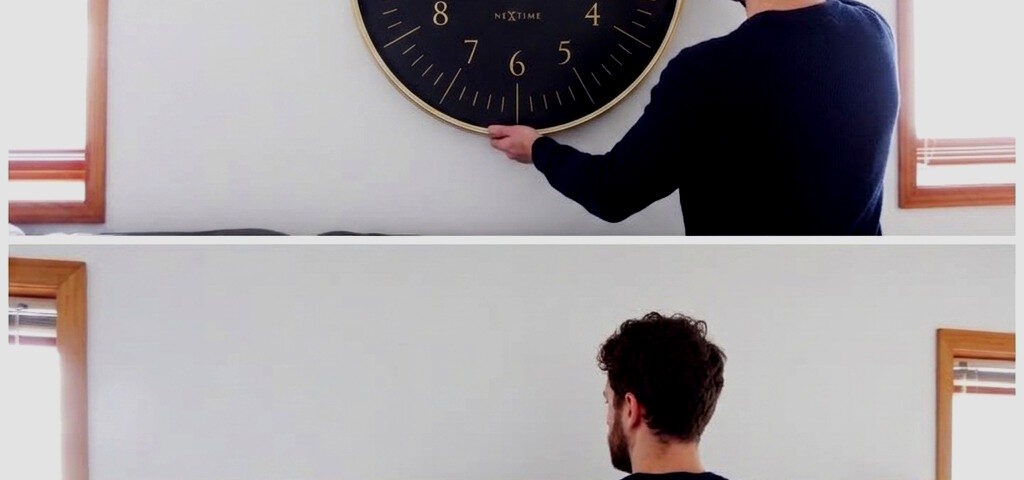
For most rooms, there is a simple starting point: hang the centre of the clock roughly at eye level when you are standing or sitting in the position where you will normally read it.
From there, adjust the height to suit the room, the furniture and the size of the clock.
What Could Be Causing the Problem?
If you’re unsure how high to hang a wall clock, the difficulty is usually not with the clock itself. It is about finding the right position for the room.
Several things affect the best height:
-
- How you normally view the clock.
A clock in a hallway is generally viewed while standing, whereas one above a sofa is often viewed while sitting.
- How you normally view the clock.
-
- The size of the clock.
A large clock can look too high if you position its centre according to a rule without considering its overall size.
- The size of the clock.
-
- Furniture underneath it.
A clock above a sofa, sideboard or dining table needs enough visual space around it.
- Furniture underneath it.
-
- The room layout.
Doors, shelves, windows and light fittings may limit where the clock can go.
- The room layout.
- The clock’s design.
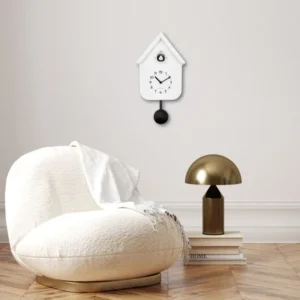
A pendulum clock, for example, needs enough clearance for the pendulum to swing freely.
There is no single height that is correct for every wall clock.
The aim is to make the clock easy to read, secure and visually balanced.
How High Should You Hang a Wall Clock?
For a clock on a relatively open wall, start by positioning the centre of the clock around average eye level.
This is only a starting point rather than a strict measurement.
Before drilling a hole, hold the clock against the wall or make a temporary paper outline of its size.
Stand where you will normally see it and check whether the position feels comfortable.
1. Decide Where the Clock Will Be Viewed From
Think about how you actually use the room.
In a hallway or kitchen, you will probably read the clock while standing.
In a living room, you may spend much of your time sitting down.
Position the clock so that you can read the face without regularly having to tilt your head upwards or downwards.
If the clock will be visible from several places, choose a position that works reasonably well from all of them rather than optimising it for just one seat.
2. Consider the Whole Clock, Not Just Its Centre
A common mistake is to mark a point on the wall and forget how much space the clock takes up above and below that point.
This matters particularly with large wall clocks.
A large clock may need to be positioned lower than you initially expect so that its face is comfortable to view and the overall arrangement does not sit too close to the ceiling.
For an unusually large clock, step back and judge the complete arrangement from across the room before making any permanent fixing.
3. Check What Is Underneath the Clock
If the wall is empty, you have plenty of freedom. Furniture makes the decision more complicated.
When hanging a clock above a sideboard, console table or similar piece of furniture, leave enough visible wall between the furniture and the clock.
You want the two to look connected without the clock appearing to sit directly on top of the furniture.
The exact gap depends on the size and proportions of both objects.
A small clock above a large piece of furniture may need a different position from a large clock above a narrow console.

4. Hanging a Clock Above a Sofa
A clock above a sofa is usually best treated as part of the furniture arrangement rather than as an isolated object.
Sit on the sofa and check the clock from your normal viewing position.
It should be comfortable to read without looking excessively high.
Avoid positioning it so low that it could easily be knocked by someone sitting down, leaning back or moving cushions.
If the clock is large, make sure it does not visually overwhelm the sofa.
A paper template can be useful for testing the size and position before you make a hole in the wall.

5. Hanging a Clock Above a Dining Table
A clock above a dining table can work well, but it should be positioned for comfortable viewing from the chairs rather than simply following a standing eye-level rule.
Sit at the table and look at the proposed position.
If you have to look sharply upwards to read the clock, it is probably too high.
Also consider the practical clearance around the table.
The clock should not be within easy reach of people sitting at the table or standing up from it.
If the clock has a pendulum or other moving parts, check that the movement has adequate space and that nothing can interfere with it.

6. Check the Fixing Before You Hang It
Before making a hole, find out how the clock is designed to be mounted.
A lightweight quartz wall clock may have a relatively simple hanging point, while a heavier clock may require a more substantial fixing.
Wall construction also matters: plasterboard, masonry and other wall types may require different fixings.
Do not rely on a fixing simply because it fits the hanging point.
It also needs to be suitable for the clock’s weight and the wall.
If you are unsure about the correct fixing for a heavy clock, ask a suitable hardware professional or installer rather than guessing.

7. Level and Test the Clock
Once the fixing is installed, hang the clock and step back.
Check that:
- The clock is secure.
- It looks level and balanced.
- You can read it comfortably from the places where you normally sit or stand.
- It does not clash with furniture, doors or other objects.
- Any pendulum or moving parts have enough clearance.
If the position does not look right, it is better to adjust it now than to live with an awkwardly positioned clock.

Things to Check and Common Mistakes
One of the biggest mistakes is assuming there is a universal measurement for every wall clock.
Rules of thumb are useful, but the way the clock is viewed and the furniture around it matter more than a precise number.
Other common mistakes include:
-
- Hanging a large clock too close to the ceiling.
-
- Positioning a clock above a sofa without checking the view from the sofa.
-
- Placing a clock so low that people can bump into it.
-
- Ignoring the weight of a large or heavy clock when choosing the wall fixing.
-
- Forgetting about pendulum movement on a pendulum clock.
-
- Drilling immediately instead of testing the position first.
- Assuming that a wall fixing suitable for one clock is automatically suitable for another.
For valuable, antique or particularly heavy clocks, take extra care.
The clock’s construction and mounting system may require specific treatment that cannot safely be generalised.
When Should I Replace the Movement or Get Professional Help?
The question of clock height is normally a straightforward DIY job, but mounting is different from repairing the clock itself.
If a clock is heavy, valuable, antique or has an unusual mounting system, consider getting professional advice before installing it.
Likewise, don’t dismantle the clock movement simply because you are having difficulty mounting or positioning it.
A movement is the mechanism that makes the clock run, and different movements have different designs and requirements.
If the clock is running poorly after being moved, stop and check the manufacturer’s instructions if available.
Mechanical and pendulum clocks can be particularly sensitive to their position, while quartz clocks generally have different requirements.
If the movement appears damaged, the clock has loose internal parts, or you cannot establish how it should be mounted safely, a clock repair professional is the better option.